
“The Hospital Is Coming Here”: Sumitra Bal and Community Care in Rural Nepal
When Sumitra Bal talks about healthcare in Ward 1 of Panauti municipality in Nepal, she talks first about distance.
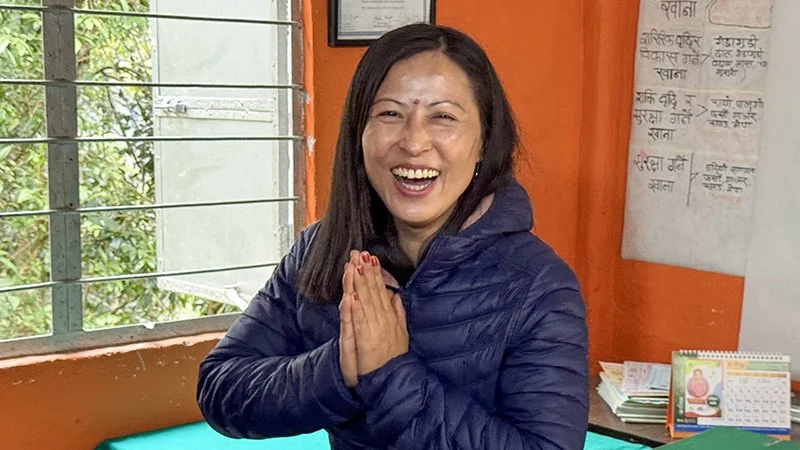
Sumitra Bal is Health Post In-Charge
“If a person is from up there,” she says, pointing uphill beyond the health post, “she has to come on foot two hours to the bus station. And then she has to take the bus, and she has to change two buses.”
As Health Post In-Charge, Bal oversees care for a population of about 5,000 people spread across remote terrain where three districts—Bhaktapur, Lalitpur, and Kavrepalanchok—meet. For years, accessing routine care for chronic conditions like hypertension and diabetes meant navigating steep paths, long walks and multiple bus rides. Many people simply didn’t come.
That began to change with an AMPATH Nepal non-communicable disease (NCD) initiative, supported by Indiana University through a grant it received from the Eli Lilly and Company Foundation, which aims to strengthen primary care systems and bring chronic disease services closer to communities in resource-limited settings in Kenya, Ghana and Nepal. In Panauti Ward 1, Bal saw the difference almost immediately.
“When we advertised about the screening camp,” she recalls, “there were comments like, ‘If the hospital is coming to the community, why should we go to the hospital?’ The hospital is already present here.”
For Bal, that shift in thinking was the project’s most powerful impact. Fourteen screening camps were held in Ward 1 including the hard-to-reach areas chosen deliberately because access was lowest. “We chose the places where the access is very less,” she says. “Like Hanidada—you have to walk two to three hours. So we went there.”
“This was the first time,” Bal says, “for screening to the remote places.”
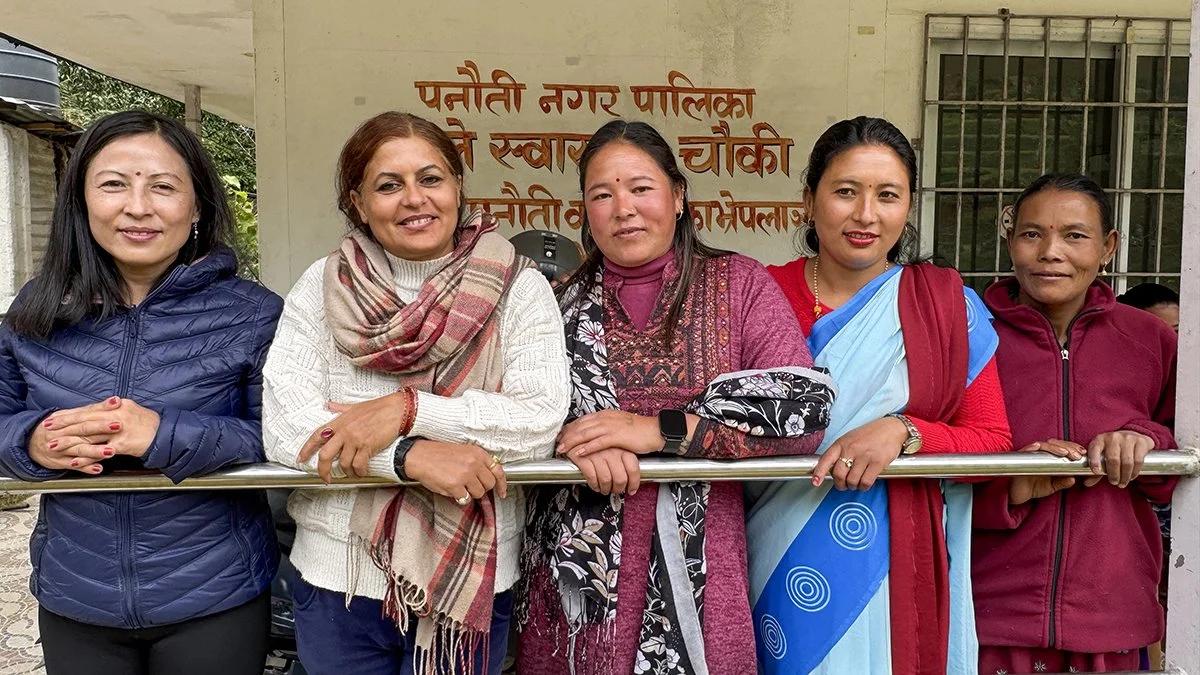
Sumitra Bal and her colleagues at the health facility in rural Nepal
The response surprised even experienced health workers. “People were so encouraged to have their checkup,” she says. For those who could not travel, the presence of the camps mattered deeply. “The elderly people who could not come to the health facilities, they were happy that we went to their community.”
AMPATH Nepal is a partnership of Dhulikhel Hospital, Kathmandu University School of Medical Sciences, and a consortium of academic health institutions, led by Mount Sinai.
Female Community Health Volunteers (FCHVs), traditionally focused on maternal and child health, were trained for the first time on hypertension and diabetes.
The screenings led to linkage to care. “To date, we have been able to help 112 people receive the medical care they need through our facility.”
Follow-up, often the weakest link in chronic care, improved as well. Bal credits a digital tracking system embedded within the project. “We could use that without the internet too,” she says. “It took time, but that’s worth it. It was very good to follow the patient.”
What impressed her most was the outreach. “Some people, their blood pressure was high and they were supposed to come for follow-up, but they didn’t come,” she explains. “What I felt very fantastic was that the team called each and every person: ‘Go to the health facility.’ And then they came.”
Necessary treatment is also provided through the government program, and patients return monthly at health posts or at outreach clinics organized by the health posts for monitoring. Bal keeps meticulous handwritten registers, tracking who is controlled, who missed visits and who has migrated elsewhere. “This one can give me the missed visits,” she says, flipping through pages. Despite the seriousness of her work, Bal speaks with warmth and humor.
She adds, “We are human beings. The future is unpredictable. We don’t know what will happen.”
What she does know is what works. Bringing care closer. Calling patients by name. Going uphill when the road runs out.
“It was very nice to have this program,” Bal says. “Hope that AMPATH Global will bring these kinds of projects in the coming future too. I’m very thankful.”
In Panauti Ward 1, the health post didn’t move—but healthcare did.